
The Top 12 Market Research Tools for Startups in 2026
Discover the top 12 market research tools for startups. Our guide covers competitive intelligence, surveys, and deep reports to help you make smarter decisions.

In a competitive landscape, assumptions are expensive, but traditional market research is slow and costly. For a startup, speed and conviction are everything. The right data can mean the difference between a breakthrough product and a solution searching for a problem. But which tools deliver actionable insights without the enterprise price tag or a steep learning curve?
This guide cuts through the noise. We have compiled and analyzed the best market research tools for startups, moving beyond generic feature lists to provide a practical evaluation tailored to early-stage needs. You will find tools categorized by their core function, allowing you to quickly identify the right solution for your specific challenge, whether you need a quick sanity-check for a new feature or a deep dive into a competitor's go-to-market strategy. We'll explore 12 powerful platforms, from rapid market validation engines to comprehensive competitive intelligence databases.
Each tool in this resource list is broken down with a clear, strategic focus. We'll cover:
- Ideal Use Cases: Pinpointing the exact scenarios where each tool excels.
- Pros & Cons: An honest assessment of strengths and limitations.
- Pricing Models: A snapshot of what to expect financially.
This curated list provides the analysis you need to build a research stack that fits your budget, answers your most pressing questions, and helps you move forward with greater confidence. Forget wading through marketing copy; this is a direct path to finding the platforms that will give your startup a decisive edge. Each entry includes screenshots and direct links to help you evaluate them efficiently.
1. StatsHub.ai
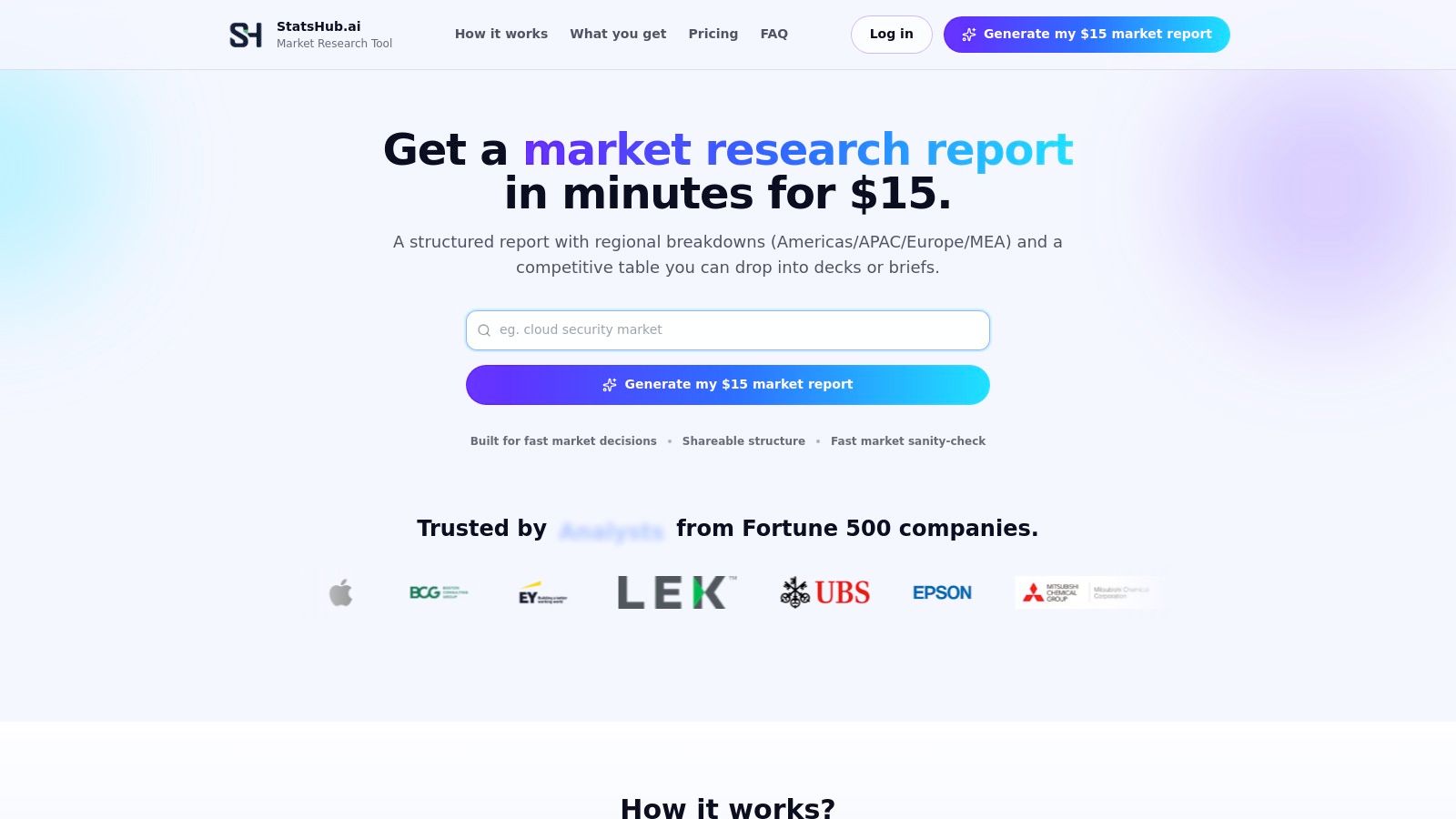
StatsHub.ai is a standout choice for startups needing to conduct rapid market assessments without the high cost and long wait times of traditional research. It’s engineered to turn a simple market keyword into a comprehensive, decision-ready report in minutes. For founders, product managers, or investors, this tool provides an immediate and structured overview of a market’s landscape, making it one of the most efficient market research tools for startups.
The platform’s core strength lies in its ability to generate slide-ready outputs that are both detailed and easily digestible. This allows teams to quickly integrate credible data into pitch decks, GTM strategies, and internal presentations, significantly accelerating the validation and planning phases of a new venture.
Core Features & Practical Applications
- Instant Report Generation: Enter a market keyword (e.g., "AI in Healthcare") and receive a structured report in 2-5 minutes. This is ideal for quickly sanity-checking a new idea or preparing for a last-minute stakeholder meeting.
- Comprehensive Structure: Each report includes an executive summary, market sizing (TAM/CAGR), segmentation, key trends, and competitive profiles. Startups can use this to build a foundational understanding of an industry without spending days on manual research.
- Competitive Benchmarking: A key differentiator is the built-in benchmarking table comparing competitors on revenue, 5-year CAGR, net margin, and regional dependence. This feature provides an immediate competitive snapshot perfect for SWOT analysis and positioning exercises.
- Global & Regional Breakdowns: Reports cover Americas, APAC, Europe, and MEA, giving startups a high-level view of global opportunities.
Pricing, Pros & Cons
| Aspect | Details |
|---|---|
| Pricing | $15 per report. A simple, one-time payment with no subscription. The company offers a credit if the output isn't useful, removing financial risk for lean startups. |
| Pros | Ultra-affordable with transparent pricing. Extremely fast delivery of editable, slide-ready content. Robust competitive data and cited methodology add credibility to your analysis. |
| Cons | Snapshot-focused: Best for initial assessments, not deep-dive primary research. Limited customization: Lacks country-level granularity and bespoke analysis options available from consulting firms. |
Bottom Line: For startups needing to validate opportunities, understand competitive dynamics, and build a data-backed narrative quickly, StatsHub.ai offers an unparalleled combination of speed, depth, and affordability. It's the essential first step before committing to more expensive, in-depth research.
Website: https://www.statshub.ai
2. Similarweb
Similarweb is a cornerstone for competitive digital intelligence, providing a comprehensive view of website and app traffic, engagement metrics, and audience demographics. For startups, it serves as a critical tool for sizing up the competition and understanding the digital landscape without commissioning expensive custom research. Its dashboards allow founders to benchmark their performance against established players, identify top traffic-driving channels, and uncover go-to-market strategies that are working for others in their space.
What makes Similarweb one of the most practical market research tools for startups is its transparent, self-serve approach. The platform offers startup-friendly packages with clear pricing and free trials, removing the friction of lengthy sales cycles typical of enterprise intelligence tools. This accessibility allows for quick validation of market assumptions.
Key Use Cases & Features
- Competitive Benchmarking: Analyze competitor traffic volume, bounce rate, pages per visit, and average session duration to set realistic performance targets.
- Channel Analysis: Discover which marketing channels (e.g., direct, search, social, referral) send the most traffic to competitors, informing your own acquisition strategy.
- Audience Insights: Gain a high-level understanding of a competitor's audience demographics and geographic distribution to refine your ideal customer profile.
| Feature | Details |
|---|---|
| Ideal For | Competitive analysis, GTM validation, digital strategy |
| Pricing | Startup-specific "Entrepreneurs" packages available, free trial offered |
| Data History (Entry Tier) | 3 months |
| Pros | Self-serve access, broad web/app data, excellent for early-stage validation |
| Cons | Limited historical data in lower tiers, costs can increase with add-ons/seats |
Website: https://www.similarweb.com
3. Semrush
Semrush is a comprehensive digital marketing and competitive intelligence suite, but its real power for startups lies in quantifying search-based market demand. It allows founders to use keyword and topic data as a proxy for market interest, analyzing search volume, CPC trends, and SERP competition to gauge the viability of a niche. This makes it an essential tool for bottoms-up market sizing and identifying the language customers use to find solutions.
What distinguishes Semrush among market research tools for startups is its ability to blend SEO analytics with broader market insights. Using its domain analytics and keyword gap features, a startup can reverse-engineer a competitor’s content and search strategy, pinpointing high-value opportunities they are missing. The platform's ecosystem of add-ons, like the Market Explorer, provides a higher-level view of market share and audience overlap, moving beyond simple keyword tracking.
Key Use Cases & Features
- Keyword-Led Market Sizing: Use keyword and topic research tools to estimate total addressable search volume for your core problems and solutions.
- Competitive Gap Analysis: Identify keywords your competitors rank for that you don't, revealing gaps in your content and go-to-market strategy.
- Share-of-Voice Tracking: Monitor your domain's visibility on key search terms against competitors to measure marketing effectiveness over time.
| Feature | Details |
|---|---|
| Ideal For | SEO-driven market validation, content strategy, competitive positioning |
| Pricing | Tiered monthly subscriptions (Pro, Guru, Business), free trial available |
| Data History (Entry Tier) | Live, rolling data with historical trend graphs |
| Pros | Robust keyword and competitor data, extensive module ecosystem, strong community |
| Cons | Core pricing can be high for early-stage startups, valuable add-ons increase cost |
Website: https://www.semrush.com
4. Ahrefs
While primarily known as an SEO powerhouse, Ahrefs serves as a formidable market research tool for startups by providing deep insights into search demand and competitor content strategies. Its massive web index allows founders to map out the digital landscape, identify audience search behavior, and discover untapped content opportunities. By analyzing what keywords competitors rank for and what content drives their traffic, startups can reverse-engineer successful go-to-market motions and find their own niche.
Ahrefs stands out with its practitioner-respected data quality, especially for backlinks and keyword difficulty metrics. The platform provides clear plan limits and offers a free Ahrefs Webmaster Tools tier, giving cash-strapped startups access to foundational site data. This makes it a scalable solution, starting with self-serve basics and growing into a full-fledged competitive intelligence suite.
Key Use Cases & Features
- Keyword & Topic Discovery: Use Keywords Explorer to gauge search volume for problem-solution phrases, validating market demand and informing your content roadmap.
- Competitor Content Analysis: Leverage Site Explorer to see which pages and content formats attract the most organic traffic and links for your competitors.
- Market Share of Voice: Track your ranking progress against competitors for a core set of market-defining keywords to measure brand visibility over time.
| Feature | Details |
|---|---|
| Ideal For | SEO-driven market validation, content strategy, competitive intelligence |
| Pricing | Tiered plans available, free Webmaster Tools tier offered |
| Data History (Entry Tier) | 6 months |
| Pros | High-quality backlink/keyword data, clear plan limits, free entry-level tier |
| Cons | Core focus is SEO, not general market data; costs rise with add-ons/users |
Website: https://ahrefs.com
5. Statista
Statista is a leading statistics portal that aggregates data from thousands of market research institutes, trade publications, scientific journals, and government sources. For startups, it acts as an indispensable resource for quickly sourcing credible data points, sizing up a Total Addressable Market (TAM), and finding chart-ready visuals for pitch decks and investor updates. Its strength lies in its breadth and accessibility, offering a one-stop-shop for statistics on virtually any industry.
What solidifies Statista's position among the best market research tools for startups is its focus on citation-ready exports. Founders can pull a specific statistic or chart, export it directly into a PowerPoint or PDF, and have the source information automatically formatted. This dramatically accelerates the process of building a data-backed business case without spending hours hunting for and formatting primary sources.
Key Use Cases & Features
- Market Sizing & Validation: Quickly find industry revenue figures, user penetration rates, and growth forecasts to validate your business idea and calculate TAM.
- Pitch Deck Enhancement: Export professional, source-verified charts and graphs to add credibility to investor presentations and marketing materials.
- Trend Analysis: Access industry reports and dossiers to understand key market trends, consumer behavior shifts, and competitive landscapes.
| Feature | Details |
|---|---|
| Ideal For | TAM sizing, pitch deck support, quick data validation |
| Pricing | Free limited access, tiered plans for individuals, SMBs, and enterprises |
| Data History (Entry Tier) | Varies by source, but often includes several years of historical data |
| Pros | Extremely fast time-to-insight, vast data library, easy chart exports/citations |
| Cons | Deep, niche coverage can be inconsistent, higher tiers are costly for startups |
Website: https://www.statista.com
6. CB Insights
CB Insights provides enterprise-grade market and technology intelligence, focusing on private companies, venture capital, and emerging tech trends. For startups aiming to understand complex ecosystems, track disruptive technologies, or prepare for fundraising, it is an invaluable strategic asset. The platform moves beyond simple firmographics, offering proprietary predictive scores like Mosaic (company health) and Exit Probability to help founders identify high-potential partners, acquisition targets, and competitive threats before they become mainstream.
What makes CB Insights one of the most powerful market research tools for startups with institutional backing is its deep, data-driven analysis of the entire venture landscape. Instead of just raw data, it delivers curated research, expert collections, and visual market maps that contextualize information. This allows leadership teams to make high-stakes decisions, like entering a new market or pursuing a strategic partnership, with a much higher degree of confidence based on forward-looking indicators.
Key Use Cases & Features
- Technology & Trend Scouting: Use the platform to identify and analyze emerging technologies and business models that could impact your industry.
- Competitive & Market Landscaping: Build detailed visual maps of competitors, partners, and investors to understand market structure and find white-space opportunities.
- Fundraising & Investor Intelligence: Analyze investor portfolios, funding trends, and company valuations to inform your fundraising strategy and identify the right VCs to approach.
| Feature | Details |
|---|---|
| Ideal For | Deep tech analysis, M&A research, investor intelligence, strategic planning |
| Pricing | Quote-based enterprise pricing; not suitable for ad-hoc or budget projects |
| Data History (Entry Tier) | Extensive historical data on private company deals, patents, and news |
| Pros | Unmatched private-market data, proprietary predictive scores, excellent visuals |
| Cons | High enterprise-level cost, can be overly complex for simple market sizing |
Website: https://www.cbinsights.com
7. PitchBook
PitchBook is an indispensable database for startups operating within the venture capital, private equity, and M&A ecosystems. It offers deep, granular data on private market transactions, company valuations, funding rounds, and investor profiles. For founders, this platform is the gold standard for fundraising strategy, competitive landscaping in the private markets, and identifying potential strategic partners or acquirers. Its comprehensive dataset allows you to map out entire industries, track investor activity, and find comparable company transaction data to inform your own valuation.
What elevates PitchBook among market research tools for startups is its focus on the private capital markets, an area notoriously opaque and difficult to research. While expensive, the platform provides direct access to the data that venture capitalists and investment bankers use daily. This levels the playing field, enabling founders to enter fundraising conversations with a sophisticated, data-backed understanding of the market landscape, recent deals, and investor theses.
Key Use Cases & Features
- Fundraising Strategy: Identify active investors in your space, analyze their portfolio companies, and find specific contacts to build a targeted outreach list.
- Competitive & Market Analysis: Track funding announcements, M&A activity, and valuation trends for private competitors to understand market dynamics and positioning.
- Valuation Benchmarking: Find data on comparable company deals (comps) to support your own valuation discussions with potential investors.
| Feature | Details |
|---|---|
| Ideal For | Fundraising strategy, M&A research, competitive intelligence, investor prospecting |
| Pricing | Quote-based; typically a significant investment not suited for bootstrapping |
| Data History (Entry Tier) | Comprehensive historical data available across all tiers |
| Pros | Extremely deep investor and deal data, recognized as an industry standard |
| Cons | High cost is a barrier for most early-stage startups, has a steep learning curve |
Website: https://pitchbook.com
8. Crunchbase
Crunchbase is the go-to platform for tracking private and public company data, focusing on funding, people, and industry trends. For startups conducting market research, it’s an essential tool for identifying emerging competitors, mapping out investment landscapes, and prospecting potential partners or customers. Its strength lies in making company and funding data accessible and easy to search, allowing founders to quickly understand who is getting funded in their space, who the key investors are, and what signals indicate market momentum.
What makes Crunchbase particularly valuable among market research tools for startups is its lean, signal-driven approach. Instead of dense financial reports, it offers high-level data points like funding rounds, key personnel changes, and recent news. The platform's flexible monthly pricing and simple onboarding process make it a low-friction choice for early-stage teams that need quick, directional insights without the commitment of an expensive enterprise data terminal.
Key Use Cases & Features
- Competitor & Investor Discovery: Use advanced search to find companies by industry, location, funding stage, and more. Track investor portfolios to identify key players in your vertical.
- Market Signal Monitoring: Set up alerts for funding announcements, acquisitions, or key hires at target companies to stay ahead of market shifts.
- Sales & Partnership Prospecting: Leverage CRM integrations and contact data add-ons to build targeted lists for outreach and business development efforts.
| Feature | Details |
|---|---|
| Ideal For | Competitor tracking, fundraising research, sales prospecting, trend analysis |
| Pricing | Free basic access; paid "Pro" and "Enterprise" tiers with monthly options |
| Data History (Entry Tier) | Full historical data available on core company records |
| Pros | Affordable monthly plan, quick discovery of company signals, easy to use |
| Cons | Data depth less than premium terminals, contact credits require add-ons |
Website: https://www.crunchbase.com
9. Research and Markets
Research and Markets operates as one of the world's largest marketplaces for syndicated market research reports. For startups needing to quickly acquire in-depth, off-the-shelf industry analysis without the time or expense of custom research, this platform is an invaluable resource. It aggregates reports from hundreds of global publishers, providing a single point of access for niche data, market sizing, and trend forecasts across nearly every conceivable industry.
What makes Research and Markets a practical tool for startups is its vast, searchable catalog and transactional nature. Instead of lengthy subscription commitments, founders can purchase a single report to validate a specific hypothesis, analyze a vertical, or prepare for an investor pitch. This model allows for targeted, on-demand intelligence gathering, which aligns perfectly with the agile and often budget-constrained startup environment.
Key Use Cases & Features
- Industry & Niche Validation: Purchase reports on specific market segments to quickly understand size, growth forecasts, key players, and regulatory landscapes.
- Investor Deck Support: Use credible, third-party data points and charts from published reports to substantiate market opportunity claims in pitch decks.
- Competitive Intelligence: Acquire detailed profiles of competitors and market share analysis to inform strategic positioning and identify potential weaknesses.
| Feature | Details |
|---|---|
| Ideal For | Niche industry sizing, investor pitch support, off-the-shelf reports |
| Pricing | Pay-per-report model; prices vary significantly by publisher and scope |
| Data History (Entry Tier) | Varies by report; historical data is often a key feature of the analysis |
| Pros | Immediate access to specialized reports, clear license types, vast selection |
| Cons | Report quality varies by publisher, single reports can be expensive |
Website: https://www.researchandmarkets.com
10. MarketResearch.com
MarketResearch.com functions as a vast digital library for syndicated market research, aggregating thousands of reports from hundreds of global publishers. For startups needing to dive deep into a specific niche, industry vertical, or geographic market, it serves as a one-stop-shop to compare and procure detailed off-the-shelf reports. This saves founders the immense time and effort of vetting individual research firms one by one.
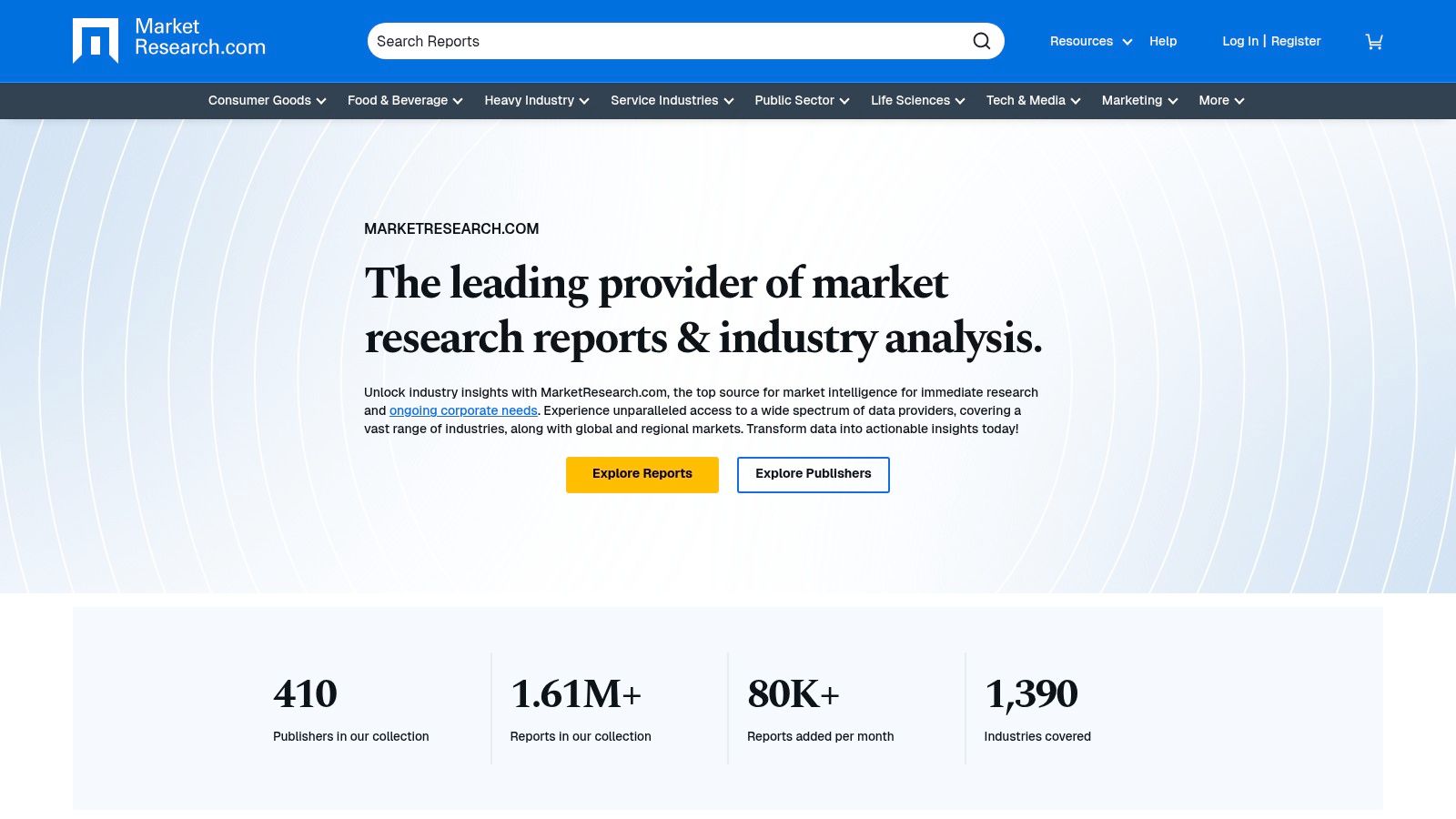
What makes this platform a practical choice among market research tools for startups is its comparison functionality. You can review tables of contents, methodologies, and report abstracts side-by-side before making a significant investment. The US-based customer support and transparent procurement process (including invoice and wire payment options) make it a reliable choice for startups needing documentation for their accounting or investors.
Key Use Cases & Features
- Publisher Comparison: Easily compare the scope, cost, and methodology of reports from different publishers covering the same topic to find the best fit for your budget and needs.
- Targeted Keyword Search: Use the "Search Inside" feature to scan the full text of reports for specific keywords, ensuring the content is relevant before you buy.
- Flexible Delivery: Receive reports in multiple formats, including instantly downloadable PDFs, online access, or even physical hardcopies for internal library purposes.
| Feature | Details |
|---|---|
| Ideal For | Niche industry analysis, investment due diligence, business plan development |
| Pricing | Pay-per-report; prices vary from hundreds to thousands of dollars |
| Data History (Entry Tier) | Varies by report; often includes 5-10 year forecasts |
| Pros | Centralized access to many publishers, US support, procurement-friendly |
| Cons | Report quality varies by publisher, hardcopy shipping fees can be expensive |
Website: https://www.marketresearch.com
11. G2 – Market Intelligence Software Category
G2 serves as an essential discovery and vetting layer in the market research process, acting as a peer-review marketplace rather than a data tool itself. For startups, its Market Intelligence Software category is a critical resource for comparing potential vendors before committing to a subscription. It aggregates user reviews, satisfaction scores, and feature comparisons, allowing founders to quickly shortlist tools that fit their stage, budget, and specific research needs. This saves invaluable time that would otherwise be spent on numerous discovery calls.
What makes G2 a practical starting point is its transparent segmentation. The platform’s famous Grid Reports and filters allow users to focus specifically on solutions favored by small businesses, providing a clear signal of which tools are genuinely accessible to startups. By reading detailed reviews from users with similar company profiles, a founder can identify potential implementation hurdles, hidden costs, or standout features that are not always apparent in marketing materials. It’s a crucial step for de-risking a software purchase.
Key Use Cases & Features
- Vendor Shortlisting: Use G2 Grid Reports to create a list of high-satisfaction, market-leading tools tailored to your company size (e.g., Small Business).
- Feature & Satisfaction Comparison: Directly compare solutions based on user ratings for specific features like “data accuracy” or “ease of use” to align with your priorities.
- Peer Review Validation: Read detailed user reviews to understand real-world pros and cons, helping to validate vendor claims and manage expectations before a trial.
| Feature | Details |
|---|---|
| Ideal For | Vendor discovery, tool comparison, pre-purchase validation |
| Pricing | Free to browse and compare; pricing for tools is set by individual vendors |
| Data History (Entry Tier) | N/A (platform aggregates reviews, does not provide market data) |
| Pros | Aggregates user feedback to save evaluation time, SMB-friendly filters |
| Cons | Review quality can be inconsistent, serves as a directory not the tool itself |
Website: https://www.g2.com/categories/market-intelligence
12. SurveyMonkey
SurveyMonkey is a leading DIY primary research platform, empowering startups to move beyond secondary data and directly validate assumptions with real audiences. Founders can quickly deploy surveys, concept tests, and pricing experiments to gather firsthand feedback. It is an essential tool for testing hypotheses generated from other market research, such as whether a specific feature resonates with a target demographic or if a proposed price point is viable.
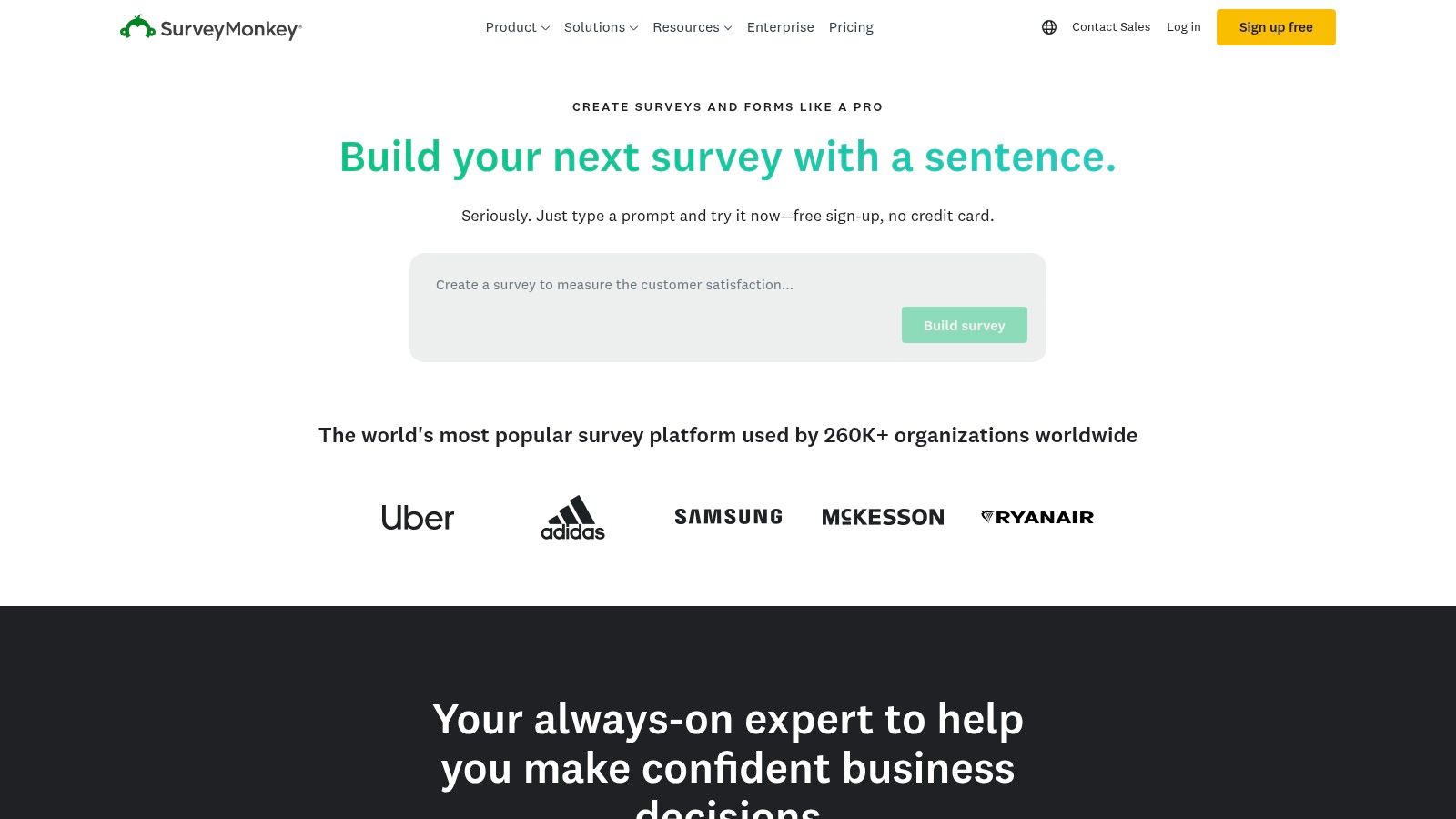
What makes SurveyMonkey one of the most accessible market research tools for startups is its low barrier to entry and powerful, user-friendly interface. Pre-built templates for concept testing or MaxDiff analysis streamline the process, while advanced logic and extensive integrations with tools like HubSpot and Slack allow for sophisticated research workflows. This combination of simplicity and power enables startups to conduct primary research without a dedicated research team.
Key Use Cases & Features
- Concept Validation: Use concept testing templates to get quantitative feedback on new product ideas, features, or marketing creative before committing development resources.
- Pricing Optimization: Run pricing sensitivity studies to understand customer willingness to pay and identify optimal price points for different segments.
- Customer Feedback: Deploy Net Promoter Score (NPS) and customer satisfaction (CSAT) surveys to measure loyalty and gather qualitative feedback for product improvements.
| Feature | Details |
|---|---|
| Ideal For | Primary research, concept testing, pricing validation, customer feedback |
| Pricing | Monthly FLEX plans and annual team options available |
| Data History (Entry Tier) | Unlimited data storage, but response limits apply to lower-tier plans |
| Pros | Low barrier to start, strong analysis/export features, scales to enterprise needs |
| Cons | Monthly plans have response caps and overage fees, team features require annual plans |
Website: https://www.surveymonkey.com
Top 12 Market Research Tools for Startups — Comparison
| Tool | Core features | UX & Quality ★ | Value & Price 💰 | Target audience 👥 | Unique selling points ✨ |
|---|---|---|---|---|---|
| StatsHub.ai 🏆 | Instant slide‑ready report (PDF + editable), regional breakdowns, competitive benchmarking | ★★★★★ | 💰 $15 one‑time, credits if unsatisfied | 👥 Founders, PMs, consultants, investors | ✨ Fast (2–5 min), cited methodology, drop‑in charts |
| Similarweb | Web/app traffic, audience, channel & alert dashboards | ★★★★☆ | 💰 Self‑serve tiers, trials (mid) | 👥 Marketers, product teams, startups | ✨ Broad digital signals + entrepreneur packages |
| Semrush | Keyword/topic research, traffic analytics, integrations | ★★★★☆ | 💰 Subscription + add‑ons (mid–high) | 👥 SEO/marketing teams, growth leads | ✨ All‑in‑one SEO + market modules |
| Ahrefs | Site/Content/Keywords explorers, rank tracker, audits | ★★★★★ | 💰 Clear plans, add‑ons (mid) | 👥 SEOs, content & growth teams | ✨ Large index, strong backlink data |
| Statista | 1M+ stats, exports, analyst reports & forecasts | ★★★★☆ | 💰 Tiered subscriptions / per‑report (mid–high) | 👥 Analysts, comms, investor decks | ✨ Fast exports + automated citations |
| CB Insights | Strategy terminal, AI tools, predictive scores | ★★★★★ | 💰 Quote‑based enterprise pricing | 👥 Strategy teams, VCs, enterprise | ✨ Proprietary scoring, deep private‑market data |
| PitchBook | Global deal & financials, Excel/PPT plugins, mobile | ★★★★★ | 💰 Quote‑based (enterprise) | 👥 Corporate dev, PE/VC, bankers | ✨ Deep VC/PE/M&A datasets & workflows |
| Crunchbase | Funding, people, alerts, CRM integrations | ★★★★☆ | 💰 Affordable monthly Pro (entry) | 👥 Sales, biz dev, early‑stage investors | ✨ Fast company discovery + simple onboarding |
| Research and Markets | Large catalog of syndicated reports, licensing | ★★★☆☆ | 💰 Pay‑per‑report / subscriptions vary | 👥 Procurement, product & strategy teams | ✨ Wide publisher catalog & license options |
| MarketResearch.com | Aggregated syndicated reports, previews & delivery | ★★★☆☆ | 💰 Pay‑per‑report; hardcopy options | 👥 Buyers comparing publishers | ✨ “Search inside” previews, US support |
| G2 – Market Intelligence | User reviews, category grids, satisfaction scores | ★★★★☆ | 💰 Free to use (vendor contact separately) | 👥 Procurement, SMBs, shortlisters | ✨ Review‑based grids by company size |
| SurveyMonkey | Survey templates, panels, integrations, exports | ★★★★☆ | 💰 Monthly/annual plans (low–mid) | 👥 Researchers, product teams, UX | ✨ Ready market research templates & panels |
From Data to Decision: Choosing the Right Tool for Your Startup's Next Move
Navigating the landscape of market research tools for startups can feel overwhelming. The options range from quick, affordable data providers to enterprise-level intelligence platforms, each promising a clearer path to market dominance. As we've explored, the solution isn't to find a single, perfect tool. Instead, the most successful startups build a dynamic, cost-effective research stack tailored to their specific stage, budget, and immediate strategic questions. The goal is to move from raw data to confident, decisive action as efficiently as possible.
This guide has dissected a dozen powerful platforms, from competitive intelligence giants like Similarweb and Semrush to deep-dive report aggregators like MarketResearch.com and specialized VC databases such as PitchBook and CB Insights. Each serves a distinct purpose. The key takeaway is to align your choice of tool with the specific "job to be done." Are you trying to validate a new feature idea, size a TAM for a pitch deck, or reverse-engineer a competitor's go-to-market strategy? The answer dictates whether you need a quick survey, a comprehensive industry report, or a web analytics platform.
Building Your Startup's Research Toolkit: Key Takeaways
The most crucial insight for an early-stage company is that market research is not a one-time event but an ongoing process. Your needs will evolve rapidly. A tool that is critical for pre-seed validation may become less relevant post-Series A, when different strategic questions emerge.
Here are the core principles for selecting the right market research tools for your startup:
- Match the Tool to the Task: Don't use a sledgehammer to crack a nut. For quick market sizing and trend validation for a pitch deck or internal meeting, a rapid-report generator like StatsHub.ai provides immediate, cost-effective insights. For deep competitive channel analysis, Semrush or Ahrefs are indispensable. For direct customer feedback, a targeted SurveyMonkey campaign is the most direct route.
- Prioritize Speed and Agility: Startups operate on compressed timelines. The value of data diminishes quickly. Tools that deliver insights in minutes or hours, not weeks, provide a significant competitive advantage. This agility allows you to test hypotheses, pivot strategies, and respond to market shifts with the speed your stage demands.
- Balance Cost and Depth: Avoid over-investing in comprehensive, enterprise-grade platforms before you have a clear, recurring need for their full feature set. Start with more affordable, high-impact tools that answer your most pressing questions. A flexible, pay-as-you-go model or a low-cost subscription is often a more prudent initial investment than a hefty annual contract.
- Integrate, Don't Isolate: The most powerful insights often come from synthesizing data from multiple sources. Combine quantitative data from a tool like Statista with qualitative feedback from customer surveys. Cross-reference competitive traffic data from Similarweb with market trend reports from Research and Markets. A holistic view, built from several specialized tools, will always be more robust than one derived from a single source.
Your Next Move: Implementing a Data-Driven Culture
Ultimately, the value of any of these market research tools for startups lies in their implementation. It's not just about acquiring access; it's about embedding a data-informed mindset into your team's workflow. Start by identifying the one or two most critical business questions you need to answer right now. Is it understanding customer churn? Sizing an adjacent market? Identifying a new content marketing angle?
Once you have your question, select the tool from this list that is best equipped to provide a fast, reliable answer within your budget. Begin with a small, focused project to demonstrate the tool's ROI. As your startup grows and your questions become more complex, you can strategically expand your research stack, layering in more specialized platforms as the need and budget arise. By taking this iterative, needs-based approach, you transform market research from a costly, intimidating function into a lean, powerful engine for sustainable growth.
Ready to get instant, affordable market insights for your next big decision? Stop waiting weeks for expensive reports and get the data you need in minutes. Start building your pitch deck or validating your next move with StatsHub.ai, the rapid-report tool designed specifically for the pace of startups.
Ready to move faster?
Generate a market report in minutes, not weeks.
$49, easy to share, and ready for your team.