
A Practical Guide to Your Go To Market Strategy
Build a winning go to market strategy with this actionable guide. Learn to define your market, find your ICP, set your price, and launch with confidence.
A brilliant product launch doesn't happen by chance. It’s the direct result of a carefully engineered go to market (GTM) strategy. Think of this guide as your complete playbook, taking you from a promising idea to a commanding market position. We'll walk through how to define your battlefield, zero in on your ideal customer, and build a message that actually connects.
Why Your Go To Market Strategy Is Your Growth Engine
A GTM strategy is so much more than a simple marketing plan. It's a comprehensive framework that gets your entire company—from product and marketing to sales and support—marching in lockstep toward one clear goal: bringing your product to market successfully. This alignment is crucial for avoiding the classic mistakes that sink launches, like marketing sending leads that sales can't convert or the product team building features for a phantom audience.
Without this strategic blueprint, companies often blow through their funding by chasing the wrong customers or launching with a message that falls completely flat. A solid GTM strategy forces you to do the hard thinking upfront, systematically de-risking the entire process. And this structured approach is more critical than ever. The Go-To-Market Strategy market itself is valued at $8.4 billion and is expected to climb to $15.6 billion by 2033, a testament to how seriously businesses are taking structured launches. You can find more details on the GTM market’s explosive growth at htfmarketinsights.com.
The Core Components of GTM
At its core, a go to market strategy is about answering a few fundamental questions that get every team on the same page. It’s a forcing function, making you define precisely what you're selling, who you're selling it to, and how you're going to reach and persuade them.
The essential pieces of this puzzle include:
- Market Definition: Sizing up the real opportunity and getting a clear picture of the competitive terrain.
- Customer Segmentation: Identifying your Ideal Customer Profile (ICP) with laser-like focus.
- Value Proposition: Clearly stating how you solve your customer's most pressing problem in a unique way.
- Channel Strategy: Figuring out the most effective routes to get your product in front of your target audience.
This flow diagram breaks down the process into its simplest form: you assess the market, define your focus, and then craft your message.
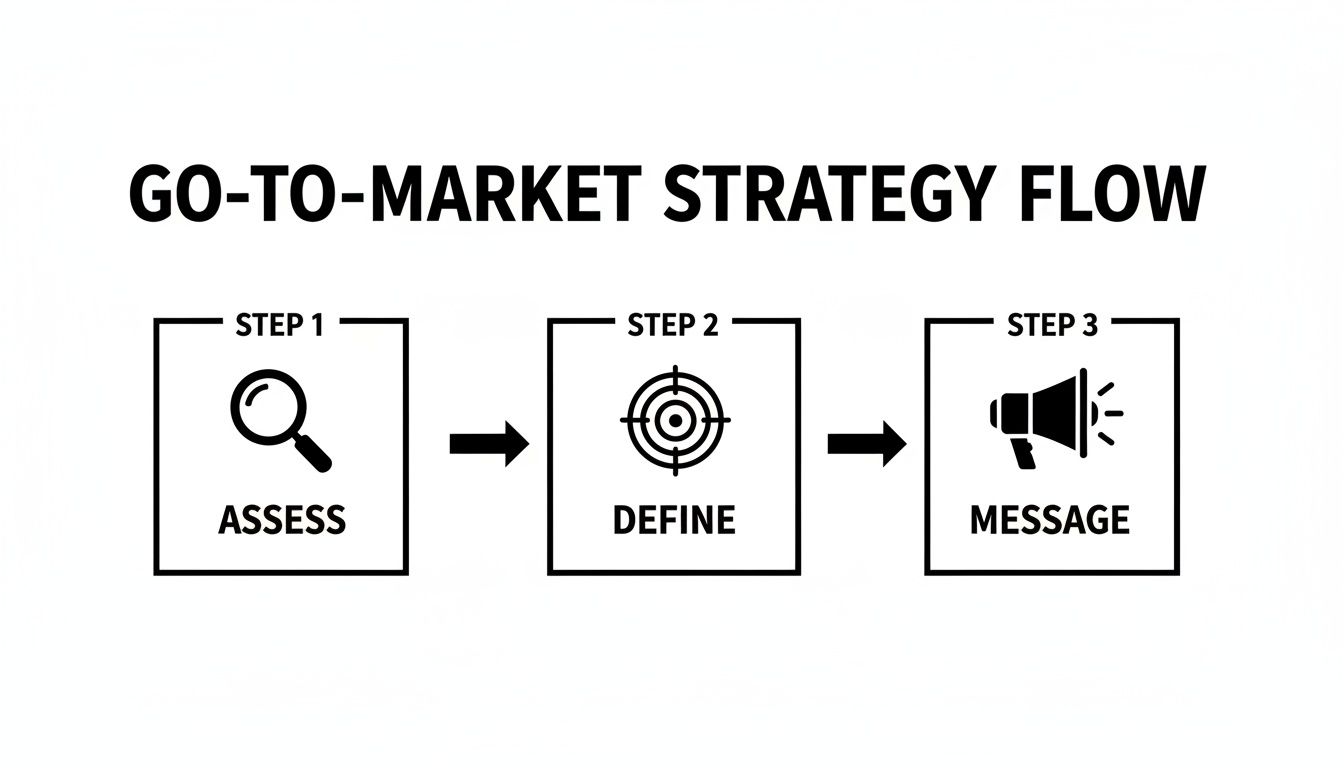
This visual is a great reminder that a strong GTM starts with deep analysis long before a single ad is run or a sales call is made.
The biggest mistake I see is companies treating GTM as a simple launch checklist. True GTM is a strategic discipline. It's the connective tissue between your product's potential and the market's reality, ensuring you build not just a great product, but a thriving business.
Throughout this guide, we'll also show how to use tools like StatsHub.ai to get the data you need to ground your strategy in facts, not assumptions. These platforms can generate slide-ready reports on market size, trends, and competitors in minutes, giving you a massive head start. This isn't abstract theory—it's an actionable framework.
2. Defining Your Market and Nailing Your ICP
Every great go-to-market strategy starts with a deceptively simple question: where will we play, and who will we win? It's not about your product, not yet. It’s about understanding the battlefield before you ever step foot on it. This is where you move from fuzzy ideas to a razor-sharp, data-backed focus.
TAM, SAM, SOM: More Than Just Investor-Speak
Your first job is to get a handle on the entire universe of potential revenue. We call this the Total Addressable Market (TAM)—the theoretical maximum demand for your solution if you were the only game in town. It's a big, exciting number, but it's not your target. It's your map's outer border.
From that massive number, you have to zoom in on the part of the world you can actually reach. That’s your Serviceable Available Market (SAM). It's the slice of the TAM that fits your current business model. For example, if your TAM is the global cybersecurity market, your SAM might be US-based financial institutions with under 1,000 employees. You're adding real-world constraints.
Finally, you get brutally honest. What piece of that SAM can you realistically capture in the next 12-18 months? This is your Serviceable Obtainable Market (SOM). It's the portion you can win given your current team, brand recognition, and competitive pressures. This is your beachhead—the hill you're going to take first.
Thinking in terms of TAM, SAM, and SOM isn't just for fundraising decks. It’s a strategic filter. It stops you from trying to boil the ocean and forces you to concentrate your precious time and money on a winnable fight.
From a Vague Market to a Vivid Customer
Defining your market is only half the puzzle. Now you need to shift from the "what" (the market) to the "who" (the customer). This is where building an Ideal Customer Profile (ICP) becomes the single most important exercise in your entire GTM plan.
An ICP isn't just a buyer persona. It's a detailed portrait of the perfect company to sell to—the kind of organization that gets immense value from your product and, in return, gives immense value back to you through revenue, referrals, and feedback.
The Three Layers of a Powerful ICP
To build a truly data-driven ICP, you need to look at three types of information:
- Firmographics: These are the hard facts about the company. Think industry, company size (both revenue and employee count), geography, and maybe even the specific technologies they use. Are we talking about 50-person SaaS startups in Austin or legacy manufacturing firms in the Rust Belt?
- Demographics: This layer gets into the people inside those companies. What are the job titles, seniority levels, and departments of the people who will buy, champion, and use your product? You need to know who signs the check and who feels the pain.
- Psychographics: This is where you strike gold. It’s the "why" behind it all. What are their biggest professional frustrations? What goals are they trying to hit? What does a "win" look like for them, and how, specifically, does your solution get them there?
Let's say you sell a compliance automation tool. A great ICP might be a 100-500 person FinTech company (firmographic) where the Head of Compliance (demographic) is completely overwhelmed by manual audits and fears the risk of costly fines (psychographic). That level of detail is the difference between shouting into the void and having a meaningful conversation.
Get a Head Start with Market Intelligence
In the old days, pulling all this data together was a soul-crushing, manual process that took weeks. You don't have to do that anymore.
You can get a massive head start by using a market intelligence platform like StatsHub.ai. In minutes, it can generate an instant, slide-ready market report that outlines market sizing, key segments, and the competitive lay of the land.
This data gives you a credible, third-party foundation for your TAM, SAM, and SOM assumptions. Instead of starting from a blank page, you begin with a structured overview. This frees you up to focus on the truly strategic work: talking to actual customers to uncover the deep psychographic insights that will make your GTM strategy unstoppable.
Crafting a Message That Resonates

Knowing your market and your Ideal Customer Profile (ICP) is a solid foundation, but on its own, it doesn't close deals. Now it's time to build the next critical layer of your go-to-market strategy: a message that cuts through the immense noise your customers face every single day. This is where you translate your product’s features into a story that solves their specific, urgent problems.
It’s not enough to be different; you have to be meaningfully different in a way your ICP genuinely cares about. This means getting past a simple list of what your product does and instead articulating the tangible outcomes it delivers. A powerful message is the essential bridge between your solution and your customer's success.
Developing Your Unique Value Proposition
Your value proposition is the heart of your message. Think of it as a clear, concise promise that explains the unique benefit you offer, how you solve a customer's problem, and why you’re a better choice than any alternative. Get this wrong, and you're left with confused prospects and a stalled sales cycle.
To build a compelling one, you have to answer three core questions from your customer’s perspective:
- What’s in it for me? How does this make my job easier, my company more profitable, or my life better?
- How do you do it? What is the specific mechanism or feature that actually delivers this value?
- Why should I believe you? What makes your solution uniquely capable of delivering on this promise compared to everyone else?
Let’s make this real. A generic project management tool might say, "We help you organize tasks." A tool with a sharp value proposition would say, "We cut project delays by 25% by automating status updates and resource allocation, freeing your managers from chasing down team members." The second one speaks directly to a painful business outcome.
A value proposition isn't a slogan or a tagline. It’s the core promise you make to a customer. If every person on your team can't articulate it in a single, compelling sentence, you don't have one yet. Your entire go-to-market strategy hinges on this clarity.
Positioning Your Product in the Market
Once your value proposition is locked in, you need to define your positioning. Positioning is all about carving out a distinct and valued place for your brand in the minds of your target audience. It’s less about what you say and more about what your customers believe about you relative to the competition.
A great positioning statement acts as an internal guidepost for your entire GTM strategy. It defines your target audience, the market category you play in, your key differentiator, and the proof behind your claims. This ensures every piece of content, every sales pitch, and every ad reinforces the same core idea.
For example, a new CRM's positioning might be: "For small B2B service businesses that feel overwhelmed by complex sales software, our CRM is the only platform that combines client management and invoicing in one simple interface, saving them ten hours a week on administrative tasks." This statement nails the who, what, and why.
Using Competitive Intelligence to Sharpen Your Message
To truly stand out, you need to know exactly what you’re standing against. This requires deep competitive intelligence—not just a casual glance at competitor websites. When you understand their messaging, their strengths, and their weaknesses, you can find the gaps in the market that your product is built to fill.
This is where a competitive benchmarking table from a tool like StatsHub.ai becomes incredibly valuable. It gives you a structured comparison of key players on metrics like revenue, growth, and regional focus. Analyzing this data helps you spot where a competitor might be financially strong but strategically vulnerable.
For instance, you might discover a major competitor has high revenue but a low five-year growth rate. That could signal market stagnation or customer dissatisfaction you can exploit. This kind of data-driven insight allows you to position your strengths directly against their weaknesses, making your value proposition much more potent and your go-to-market strategy far more effective.
Choosing Your Pricing and Distribution Model

Alright, you've defined your market and crafted a killer value proposition. Now we get to the brass tacks: How much will your product cost, and how are you going to get it into your customers' hands?
Don't treat pricing and distribution as afterthoughts. These two decisions are deeply connected and form the very core of your business model. They dictate your profitability, shape your market perception, and ultimately determine how you scale. Get them right, and you create a smooth, frictionless path to purchase. Get them wrong, and even the most brilliant product can stall out before it ever gets going.
Think about it this way: a high-touch, enterprise product with a six-figure price tag demands a completely different operational structure than a low-cost, self-serve tool. This is the point where your GTM strategy transforms from a set of ideas into a concrete, operational plan.
Selecting the Right Pricing Model
Your pricing strategy is far more than a way to bring in revenue—it's a powerful signal of your product's value. It’s a critical part of your positioning that tells the market exactly where you fit. While the options can seem endless, most pricing models fall into a few key categories.
- Value-Based Pricing: This is the gold standard if you can pull it off. You anchor your price to the tangible, economic value your product delivers. If your software saves a company $100,000 a year, pricing it at $10,000 suddenly feels like an incredible deal. This approach requires you to deeply understand your customer's ROI, but it almost always unlocks the highest margins.
- Competitor-Based Pricing: Here, you're simply positioning your price relative to what’s already out there. You might price just below a market leader to snag cost-conscious buyers or deliberately price above them to signal a more premium, feature-rich offering. It’s definitely easier to implement, but it risks dragging you into a race to the bottom and can completely disconnect your price from your product's actual value.
- Cost-Plus Pricing: This is the most straightforward method: calculate your total costs to build and deliver the product, then add your desired markup. While it guarantees you'll be profitable on every single sale, it's a very inward-looking approach that completely ignores market dynamics and what the customer thinks your product is worth.
Beyond the core model, you need to think about packaging. Tiered pricing (like Basic, Pro, and Enterprise plans) is incredibly popular for a reason—it lets you align specific feature sets with different customer segments. This creates a natural upgrade path, allowing customers to start small and grow with you. A freemium model can also be a potent customer acquisition engine, but you absolutely need a clear, well-defined strategy for converting those free users into paying customers.
Mapping Your Distribution Channels
So, how will your product physically (or digitally) get to the customer? Your distribution channel is one of the most significant choices you'll make in your entire GTM strategy. It directly impacts your cost of customer acquisition (CAC) and your ability to scale. The path you pick must align with your product’s complexity, its price point, and how your target customer actually likes to buy things.
Choosing a distribution channel isn’t just a logistical decision; it's a strategic one. A direct sales force gives you control but is expensive. A self-serve model is scalable but offers no hand-holding. The right channel meets your customers where and how they prefer to buy.
Before you launch, it's essential to have all your strategic components locked in. A simple checklist can help ensure no stone is left unturned.
Go To Market Strategy Components Checklist
A quick check to make sure all the critical pieces of your GTM strategy are thought through and ready for action.
| Strategy Component | Key Question to Answer | Status (Not Started, In Progress, Complete) |
|---|---|---|
| Market Definition | What is the total addressable market (TAM) and our serviceable market (SAM)? | |
| Ideal Customer Profile (ICP) | Who are we selling to, and what are their specific pain points? | |
| Value Proposition | How does our product uniquely solve the ICP's problem? | |
| Positioning & Messaging | How do we want to be perceived in the market? What is our core story? | |
| Pricing & Packaging | What is our pricing model and how are our features tiered? | |
| Distribution Strategy | How will customers buy and receive our product (e.g., direct, channel)? | |
| Marketing Plan | What channels will we use to generate awareness and leads? | |
| Sales Plan | How will the sales team engage leads and close deals? | |
| Launch Plan & Checklist | What are the specific tasks and timelines for the public launch? | |
| KPIs & Measurement | How will we define and track success post-launch? |
Having this checklist completed gives you the confidence that your strategy is comprehensive and ready for execution.
Analyzing Channel Options
Let's break down the most common distribution models and where they fit best.
Direct Sales: This is your classic, in-house sales team. It's the best fit for complex, high-value enterprise products that need a consultative sales process and deep relationship-building. You get high deal values and direct market feedback, but the cost of sale is extremely high, sales cycles are long, and it's tough to scale quickly.
Channel Partners: This involves working with third parties like resellers, value-added resellers (VARs), or distributors. It’s ideal for products that benefit from integration with other systems or that need a local presence and expertise. This route offers rapid market access and lets you tap into your partners' existing customer bases, but you'll have to share margins and give up some control over your brand's messaging.
Self-Serve / Product-Led Growth (PLG): This model is built for lower-cost, intuitive products where users can sign up and see value almost immediately without any human help. It's highly scalable with a low CAC and offers a fantastic, frictionless buying experience. The catch? It requires a truly exceptional product and often results in a lower average revenue per user (ARPU).
For many companies, the winning formula isn't choosing just one channel but developing a hybrid approach. You could use a self-serve model to efficiently acquire small businesses while deploying a direct sales team to hunt for much larger enterprise deals.
To make an informed decision, let data be your guide. A market report from a platform like StatsHub.ai can deliver a clear breakdown of the dominant distribution channels within your specific industry. Understanding how established players are reaching their customers helps you spot the standard practices and, more importantly, find potential gaps where you can innovate. This insight can give your GTM strategy the competitive edge it needs to succeed.
All the brilliant strategy in the world is just an expensive paperweight if it never leaves the document. This is where the rubber meets the road—the moment your carefully laid plans for market definition, customer segments, and messaging have to survive contact with the real world.
This transition from planning to execution is precisely where most GTM initiatives either catch fire or fizzle out. It's all about turning your strategy into a coordinated, real-world launch.
The first, most critical task is getting your sales and marketing teams perfectly in sync. I don't just mean aligned on a high level; they need to be speaking the same language, chasing the same leads, and telling the exact same story. This isn't something a single kickoff meeting can solve. It requires a shared playbook.
Building Your Launch Playbook
Think of the launch playbook as the tactical blueprint for your entire operation. It's the "how" that follows the strategic "what" and "why." It breaks down the big picture into a series of concrete actions, assigns clear owners, and sets firm deadlines. This is the guide that keeps everyone marching in lockstep.
A solid playbook ensures marketing's demand-generation efforts flow seamlessly into sales conversations, creating a smooth and effective customer journey.
Here’s what a truly effective launch playbook needs:
- A Detailed Launch Timeline: Don't just list dates. Create a shared calendar that maps out every key milestone, from generating pre-launch buzz to the debrief and analysis after the launch is complete.
- Actionable Sales Enablement Materials: This is your sales team's arsenal. It should include everything from battle cards detailing competitor weaknesses to proven email templates, demo scripts, and powerful case studies that make your value proposition tangible.
- A Clear Marketing Campaign Cadence: This plan outlines exactly which channels you'll activate and when. It should cover your content marketing pipeline, paid ad campaigns, social media schedule, and any PR efforts.
- Ironclad Handoff Protocols: You have to define the exact criteria for when a Marketing Qualified Lead (MQL) becomes a Sales Qualified Lead (SQL). Getting this wrong is the number one cause of friction and dropped leads between teams.
This kind of operational rigor is what separates a successful launch from just wishful thinking. In fact, companies with a documented GTM framework achieve a 10% higher success rate in product launches and see three times the revenue growth of those without one. Even so, only 33% of companies actually have a formal GTM playbook. You can find more data on the impact of a structured GTM framework from Salesmotion.io.
Defining Your Key Performance Indicators
The moment your product hits the market, your focus must immediately pivot to measurement. A GTM strategy isn't a "set it and forget it" plan. It's a living thing that needs constant refinement based on real data. Without the right Key Performance Indicators (KPIs), you're flying blind, unable to tell a temporary hiccup from a fundamental flaw in your strategy.
You cannot improve what you do not measure. From day one, your GTM strategy must be tethered to a core set of metrics that tell you the unbiased truth about what's working and what isn't. Data is the feedback loop that fuels optimization.
Your mission is to build a GTM dashboard that gives you a real-time, no-nonsense view of performance. This isn't about chasing vanity metrics. It's about zeroing in on the numbers that directly reflect the health of your business and the true effectiveness of your strategy.
Your GTM dashboard must track these essentials:
- Customer Acquisition Cost (CAC): This is your total sales and marketing spend divided by the number of new customers you brought in. It bluntly answers the question: "How much does it cost us to win a new customer?"
- Lifetime Value (LTV): This metric forecasts the total revenue you can realistically expect from a single customer over their entire relationship with you. For a healthy business model, your LTV needs to be significantly higher than your CAC, typically by a ratio of at least 3:1.
- Conversion Rates: You need to obsess over conversions at every stage of the funnel—from website visitor to lead, lead to MQL, MQL to opportunity, and finally, opportunity to a closed-won deal. This is how you find the leaks in your process.
- Sales Cycle Length: On average, how long does it take to close a deal from the very first touchpoint? A shortening sales cycle is a powerful sign that your messaging and targeting are getting sharper and more effective.
Keeping a close eye on these KPIs allows you to make quick, data-driven adjustments. Is your CAC creeping up? It might be time to re-evaluate your marketing channels. Are conversion rates dropping off between the MQL and opportunity stages? Your sales team might need better training or materials. This constant feedback loop is the engine that drives a successful and adaptive go-to-market strategy.
Learning From Successful Go-To-Market Strategies

Theory is great, but the most powerful lessons come from dissecting the real-world GTM playbooks of iconic brands. A masterfully executed go-to-market strategy is what separates a legendary product launch from a forgettable one. These examples are more than just success stories; they're blueprints for what happens when every piece of the puzzle fits perfectly.
By looking at how others have moved from a simple concept to a beloved product, you can start to see the patterns. It’s about recognizing how a struggling brand can be reborn, how a new category can be carved out of nothing, or how a local favorite can go global.
Apple: From Near-Bankruptcy to Design Icon
Remember Apple in the late 90s? The company was teetering on the edge. The 1998 launch of the iMac G3 had to be a game-changer, and its GTM strategy was built around one core idea: simplicity and design.
Instead of getting into a spec war with other PC manufacturers, Apple targeted a completely different audience. They focused on students, artists, and families who were put off by the complicated, beige-box computers of the era. The iMac’s colorful, all-in-one form factor was the physical proof of their value prop, and the legendary "Think Different" campaign drove that message home. This laser focus on a specific customer with a perfectly tailored message pulled the company back from the brink.
Slack: Creating a Category Through Product-Led Growth
Slack’s story is a modern classic in building and owning a new market category. They didn’t just make a better chat app; they completely changed the conversation around internal business communication.
Their entire GTM was anchored in a frictionless, product-led approach. By offering a robust freemium version, they allowed small teams to jump in, discover the value for themselves, and then become powerful advocates inside their own companies. It was a brilliant, bottom-up sales motion that required very little traditional marketing spend to get started.
Slack’s success is a testament to the power of a product-led go-to-market strategy. They obsessed over creating an indispensable user experience, rightly believing that an amazing product can become its own best sales and marketing engine.
This model worked spectacularly. By 2019, Slack's disruptive GTM had captured 8 million daily active users and 3 million paying customers, which ultimately led to its massive $27.7 billion acquisition by Salesforce. You can find more deep dives on how GTM drives this kind of explosive growth in these go-to-market examples.
Starbucks: Conquering the Globe with a Local Touch
Starbucks provides a masterclass in how a GTM strategy must evolve for global expansion. As they moved into new countries, they didn’t just copy and paste their American storefront. They skillfully wove their core brand DNA into the fabric of local culture.
For instance, in China, they marketed their cafes as a premium "third place" for socializing and business, a concept that resonated deeply. In Italy, they showed reverence for the established coffee tradition by opening a high-end roastery and espresso bar. This careful localization, from store design to the menu itself, was key. It proves that a successful international go-to-market strategy isn't rigid; it requires humility, flexibility, and a genuine respect for regional tastes.
Frequently Asked Go-To-Market Questions
Even with the best playbook in hand, you're bound to hit a few roadblocks during GTM planning. It happens. Getting past them quickly is what separates a smooth launch from one that gets stuck in analysis paralysis.
Here are some of the most common questions—and my straight-shooter answers—that come up when teams are in the trenches, building their strategy.
How Long Should It Take to Build a GTM Strategy?
There's no magic number here, but a realistic timeline is somewhere between 3-6 months for a brand-new product launch. If you're a scrappy startup, you might be forced to compress that timeline. On the other hand, if you're a global enterprise breaking into a new region, it could easily take longer.
The one non-negotiable? Don't rush it. Proper research and getting everyone on the same page are the bedrock of a solid plan. I’ve seen too many teams try to speed through this phase, and they almost always pay for it later.
Your GTM plan isn't a box to be checked; it's the foundation for your product's success. Rushing validation and alignment stages to meet an arbitrary deadline is one of the most common—and costly—mistakes I see teams make.
When Is It Time to Pivot the Strategy?
Pivoting isn't an admission of failure. It's a sign of a smart, agile team that's paying attention to the market. You should seriously consider a major shift in your go-to-market approach when the data tells you your core assumptions were flat-out wrong.
Look for these tell-tale signs:
- Conversion Rates That Won't Budge: You've tweaked the messaging and run A/B tests, but leads just aren't converting. This often means your core value proposition isn't resonating.
- A Revolving Door of New Customers: High churn among your first wave of customers is a massive red flag. It points to a mismatch between your Ideal Customer Profile (ICP) and the product's actual value.
- Getting Consistently Beaten by the Same Competitor: When you keep hearing, "We went with Competitor X instead," it’s time to take a hard look at your positioning and differentiation.
It's always better to make a data-backed pivot than to stubbornly stick with a plan that's clearly failing.
Don't build your strategy on guesswork. Get instant, slide-ready market reports from StatsHub.ai to validate your assumptions and build a GTM plan grounded in credible data. Get your first report in minutes at https://www.statshub.ai.
Ready to move faster?
Generate a market report in minutes, not weeks.
$49, easy to share, and ready for your team.